Quick summary: a one-color coloring book asks you to fill each page with a single pencil or marker instead of choosing from a full palette. That removes the biggest source of friction in adult coloring – the decision – and turns a session into something closer to a quiet routine. Not every book that calls itself “monochrome” works the same way, so this checklist covers the five things worth checking before you buy.
What one-color coloring actually feels like
With a full palette, most of the first ten minutes go to planning: which green for the leaves, whether the sky should be blue or lilac, whether two colors will clash. With one color, that part disappears. You notice pressure, texture and the shape of the empty space instead. People who color to switch off after work tend to say the same thing: it feels less like making art and more like following a calm visual task, and that is the point.
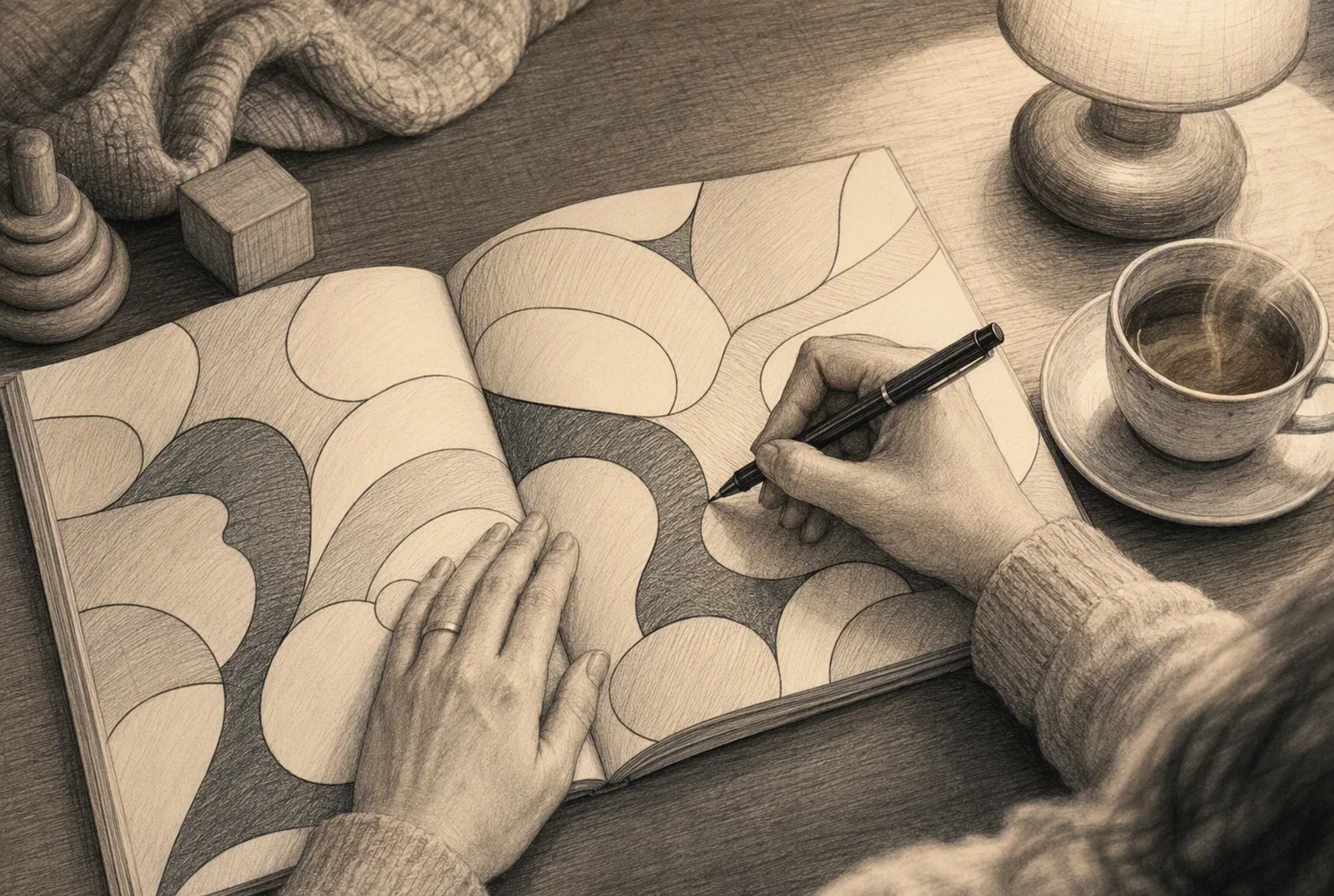
The finished page is where books differ. Some leave heavy black outlines that stay visible whatever you do; the page looks like a worksheet that has been filled in. Others print the artwork as very pale gray shapes with no outlines at all, so once the gray is covered the page reads as a finished piece.
1. How does the page guide you?
This is the first thing to look at, because it decides what your finished page will look like.
- Outline guides – classic line art. Familiar and easy, but the black lines remain.
- Marked guides – dots, numbers, X’s or symbols inside each region tell you what to fill. Useful for beginners; the marks stay visible after coloring.
- Mark-free gray guides – the design is printed as flat, pale gray shapes on white with no lines and no marks. You simply color the gray. Nothing shows through when you are done, so the page looks like art rather than a filled-in template. This is the approach we use at Soft Ink Press: no dots, no numbers, no symbols – one pencil is enough.
If you want your finished pages to be frame-worthy, mark-free guides are the deciding feature. If you want maximum hand-holding while you learn, marked guides are fine.
2. Is the book printed single-sided?
One-color coloring invites markers, and markers bleed. A single-sided book keeps every design safe: whatever soaks through lands on a blank page, not on the next picture. Double-sided books are cheaper to print, which is why they are common; they are also why so many colorists slip a sheet of card behind the page. Check the listing or the product description for “single-sided” before anything else.
3. Paper weight and finish
Heavier paper (roughly 90-120 gsm and above) takes pencil layering and alcohol markers without pilling. A smooth, bright white finish shows the pale gray guide clearly – important for mark-free pages, because the guide has to be visible enough to follow and light enough to vanish under color. Printable PDFs let you choose your own paper, which is one reason many people start with a printable pack before buying a bound book.
4. Page count and design count are not the same thing
A single-sided book of about 100 pages holds roughly 50 designs, because the reverse of each page is blank. That is a full book. Listings that quote “100 pages” for a double-sided book are giving you the same number of designs on thinner, shared sheets. Compare design counts, not page counts.
5. Binding, size and how you will use it
- Size: 8.5 x 11 inches (US Letter) is the standard for adult coloring; it gives large, open shapes without crowding.
- Binding: spiral bindings lie flat; perfect-bound paperbacks need a gentle crease or a book weight. Neither is wrong – a spiral is easier at a desk, a paperback travels better.
- Complexity: decide whether you want a ten-minute page or an hour-long one. Layered, detailed scenes reward long sessions; large, simple shapes suit short breaks. A good book tells you which it is.
Which color should you use?
Black is the traditional choice because it gives the strongest contrast, but it is not a rule. A deep green, a warm rust, a navy or a plum all work; what matters is enough contrast against the white paper that the shapes read clearly. Pencils give you pressure control and layering; a single alcohol marker gives the classic flat, graphic look. Try both on a printable page before committing a whole book to one medium.
A note on expectations
Coloring is a reliable way to take a screen-free pause and settle a busy mind for twenty minutes. It is not a treatment for anxiety, and no book should promise that. What a well-designed one-color book does offer is a low-decision, repeatable routine you can return to on an ordinary evening – which, for most of us, is exactly what we were looking for.
Try a page before you choose
The quickest way to know whether mark-free, one-color coloring suits you is to print one page and sit with it for ten minutes. Our free printable pages are drawn the same way as the books: pale gray shapes on white, no outlines, no dots or numbers. Print at 100% on plain paper, pick one pencil, and see how it feels.
Frequently asked questions
Can I use more than one color in a one-color coloring book?
Yes. The format is designed so that one color is enough, not so that one color is required. Many people use one color per page and vary it across the book.
What is the difference between monochrome, grayscale and one-color coloring?
“One-color” and “monochrome” usually mean the same thing: you color with a single hue. “Grayscale” pages are printed with shaded gray tones that you glaze over with color – a different technique that keeps the printed shading visible.
Which pens work best?
Pencils for control and layering; fine liners for dotted or detailed pages; a single alcohol marker for flat, high-contrast fills – on single-sided, heavier paper.