Quick summary: “relaxing coloring pages” is not one thing. Mandalas calm through symmetry and repetition, botanicals through recognisable, organic shapes, and patterns through rhythm. The style that works for you depends on how much time you have and whether you want to think a little or not at all. This guide explains the three styles, how to match them to a session, and what to look for in the page itself.
Mandalas: symmetry does the thinking
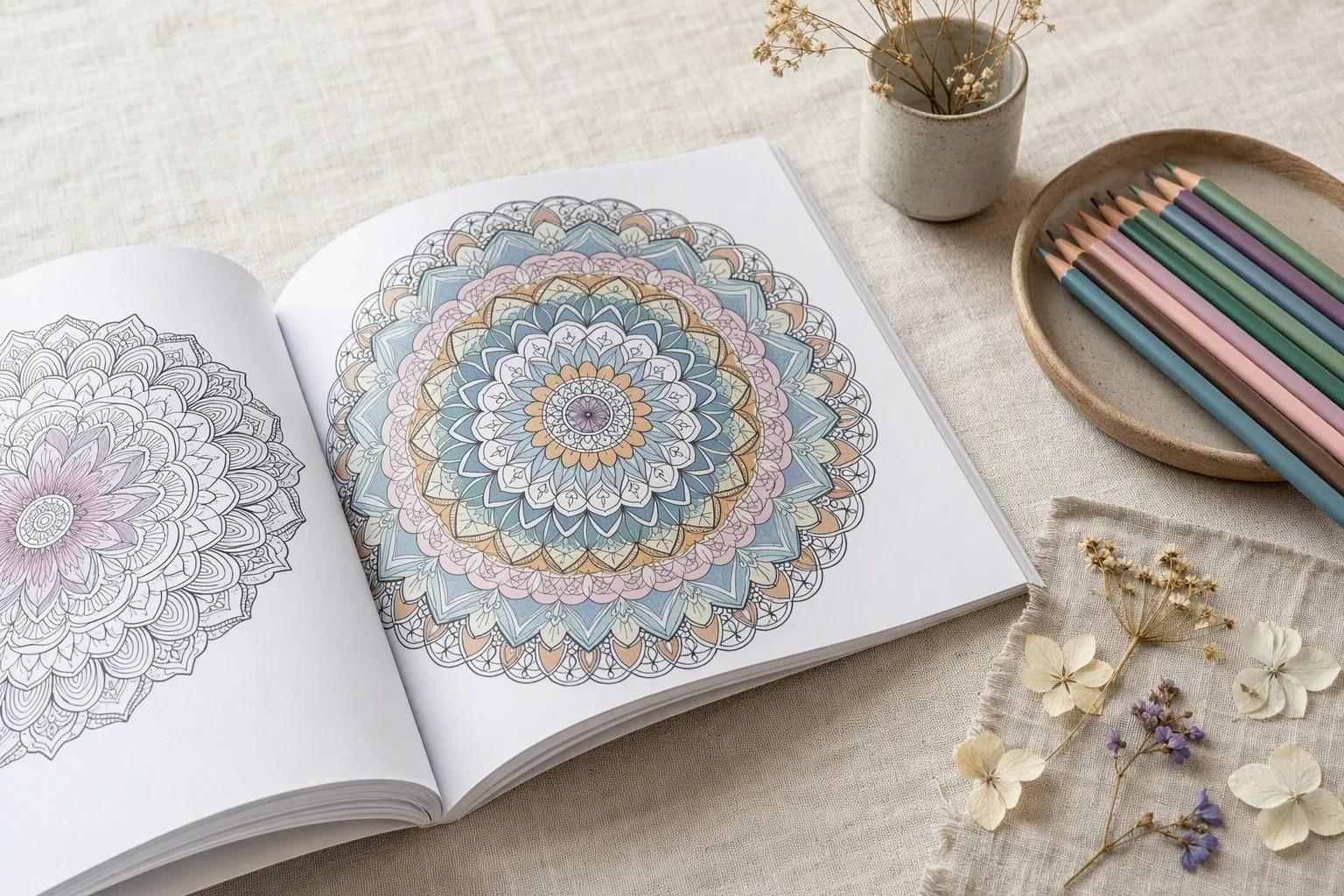
A mandala is a circle built from repeated segments. Once you have colored one segment, the next is decided for you, which is why mandalas feel meditative: the composition is solved before you start. They suit people who want a defined task and a satisfying, complete result.
- Best for: 30-60 minute sessions, evenings, anyone who likes finishing things.
- Watch out for: very fine segments near the centre. Dense mandalas can flip from calming to fiddly. Look for open centres and larger outer rings.
- One-color tip: vary pressure ring by ring – light at the edge, darker toward the centre – and a single pencil gives you a full gradient.
Flowers and botanicals: shapes you already know
Petals, leaves and stems are familiar, so your hand knows what to do without instructions. Botanical pages are the most forgiving style for beginners and the most natural fit for one-color coloring: a whole garden in one green reads as a drawing, not a mistake.
- Best for: 15-30 minutes, mornings, people who want something to look at when it is done.
- Watch out for: tangled line art with dozens of tiny leaves. The calmest botanical pages leave white space around each element.
- Mark-free pages: when a flower is printed as pale gray shapes with no outline, the finished page looks like a print. This is the style all Soft Ink Press pages use: no dots, no numbers, no symbols, one pencil is enough.
Repeating patterns: rhythm, not decisions
Tiles, waves, scallops and lattices ask nothing of you except to keep going. Patterns are the closest coloring gets to knitting: the hand moves, the mind wanders, and there is no “wrong” region to worry about. They are ideal when you are too tired to make choices at all.
- Best for: 10-20 minutes, stressful days, waiting rooms, travel.
- Watch out for: patterns with no variation can become monotonous; the best ones drift slightly across the page.
- Tip: dotted or gray-guided patterns let you stop anywhere and the page still looks intentional.
A quick way to choose
| You want to | Try | Time |
|---|---|---|
| Finish something and feel satisfied | A mandala with an open centre | 30-60 min |
| Make something you will keep | A botanical page with white space | 15-30 min |
| Stop thinking entirely | A repeating pattern | 10-20 min |
What to look for in any style
- Space between shapes. Crowded pages tire the eye whatever the subject.
- How the page guides you. Outlines, marks (dots, numbers, symbols) or mark-free gray shapes. Marks stay visible after coloring; gray guides disappear under it.
- Page size. 8.5 x 11 inches gives room for large, calm shapes.
- Single-sided printing if you use markers.
- A theme you like looking at. You will return to pages you would happily hang up.
Try a page before you choose
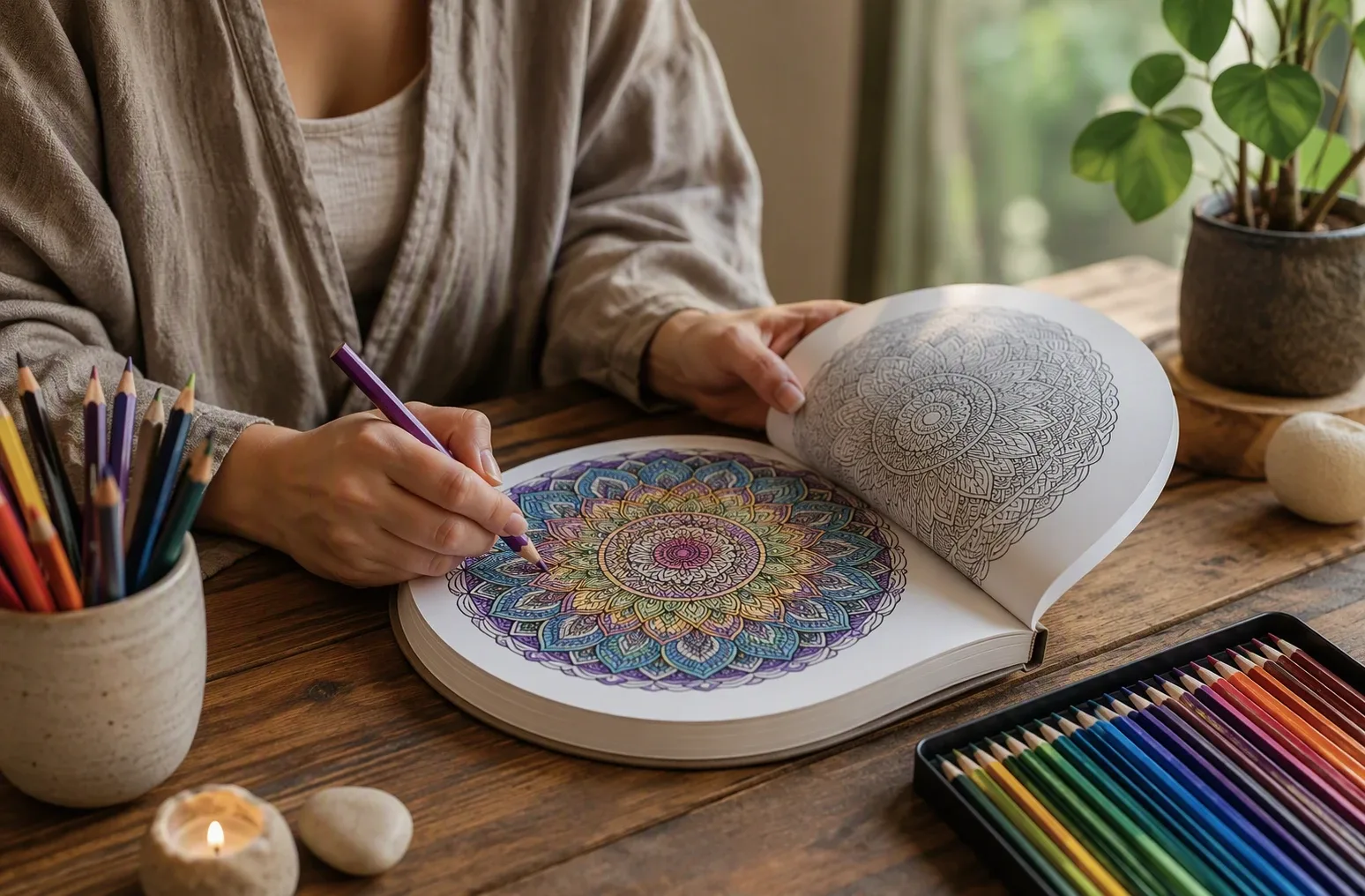
The quickest way to know whether mark-free, one-color coloring suits you is to print one page and sit with it for ten minutes. Our free printable pages are drawn the same way as the books: pale gray shapes on white, no outlines, no dots or numbers. Print at 100% on plain paper, pick one pencil, and see how it feels.
Frequently asked questions
Are mandala coloring pages good for stress?
Many people find the symmetry and repetition settling for a short session. It is a pleasant, screen-free pause rather than a treatment, and it works best when the page is not overly dense.
What is the most relaxing coloring style for beginners?
Botanicals with open white space are the most forgiving: the shapes are familiar and one color looks finished.
Can I use one color on a mandala?
Yes. Vary pressure from ring to ring and a single pencil produces a full tonal range.